
Buyer Guide
Cycling Glasses vs Running Glasses: What Actually Differs
Both are sports eyewear, but they solve different problems. If you buy for a shop, a team or a distributor, this is what to compare before you commit to a range — and which WORLUX models sit on each side.
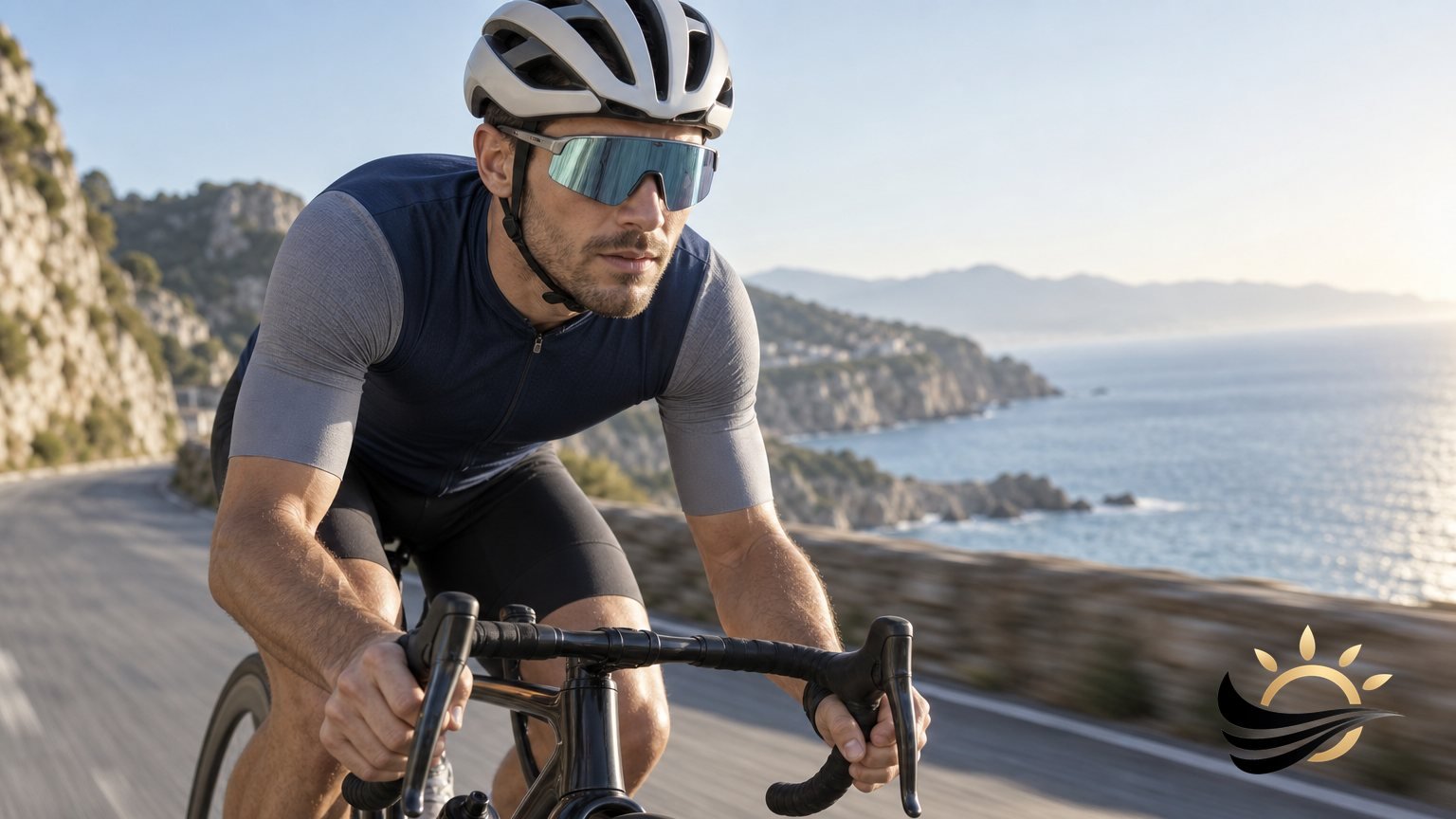
Walk into any cycling shop and you will see shield-style glasses with one large lens. Walk into a running store and you will see smaller, lighter frames that look almost like everyday sunglasses. The difference is not fashion — it comes from what the two sports demand from a frame.
The five differences that matter to buyers
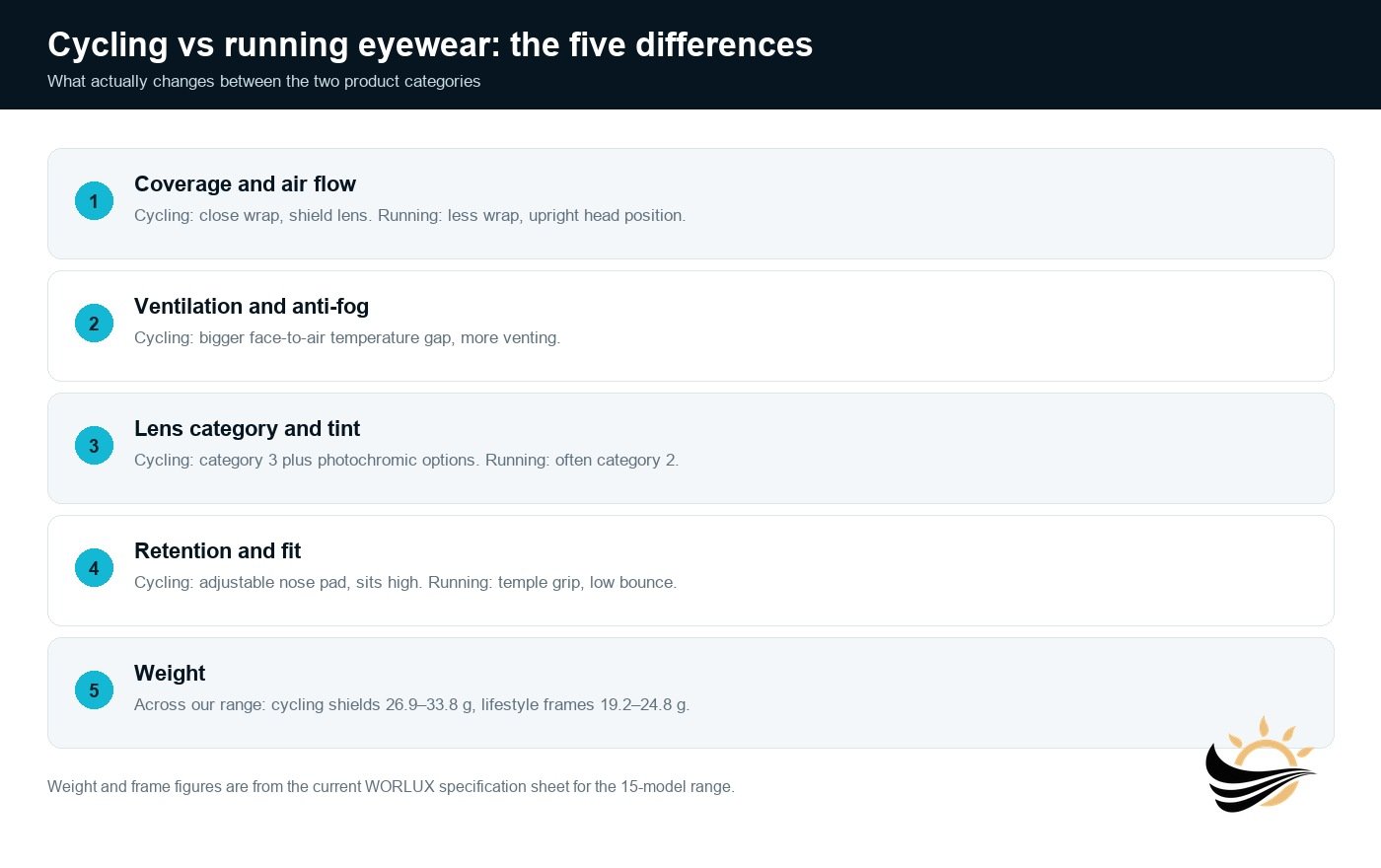
1. Coverage and air flow
Cyclists ride at 25–45 km/h. At that speed the eyes water, and wind and grit come at the face from the front. Cycling eyewear therefore wraps close to the face, and shield designs (one continuous lens) remove the frame edges that can catch wind or distort the view. Running happens at 10–16 km/h with a much more upright head position, so runners need less wrap and benefit more from a frame that does not trap heat.
What this means commercially: cycling models are built around coverage and ventilation; running models around weight and stability.
2. Anti-fog and ventilation
Both sports sweat, but cycling creates a bigger temperature gap between the face and 30 km/h of moving air, which is why cycling eyewear puts more effort into venting. Look at lens coating and frame vents rather than at colour.
3. Lens tint, category and light conditions
Cycling is often an all-day activity that starts in low light and finishes in full sun. Running is more often 30–60 minutes at a single light level. That is why cycling ranges lean on mirrored and category 3 lenses (8–18% light transmission) and why some buyers add a photochromic option, while running ranges sell well with category 2 (18–43%).
4. Retention and fit
A runner moves vertically; a cyclist sits still but vibrates and looks down at the road with the head tilted. Cycling frames therefore use adjustable nose pads to sit high and stay clear of the brow, while running frames rely on a secure temple grip and a low weight so the frame does not bounce.
5. Weight
Our own range shows the pattern: the cycling shields run 26.9–33.8 g because of the lens area and the wrap structure, while full-rim lifestyle and optical models sit at 19.2–24.8 g. Weight is a specification you can sell on, so put it on the shelf talker.
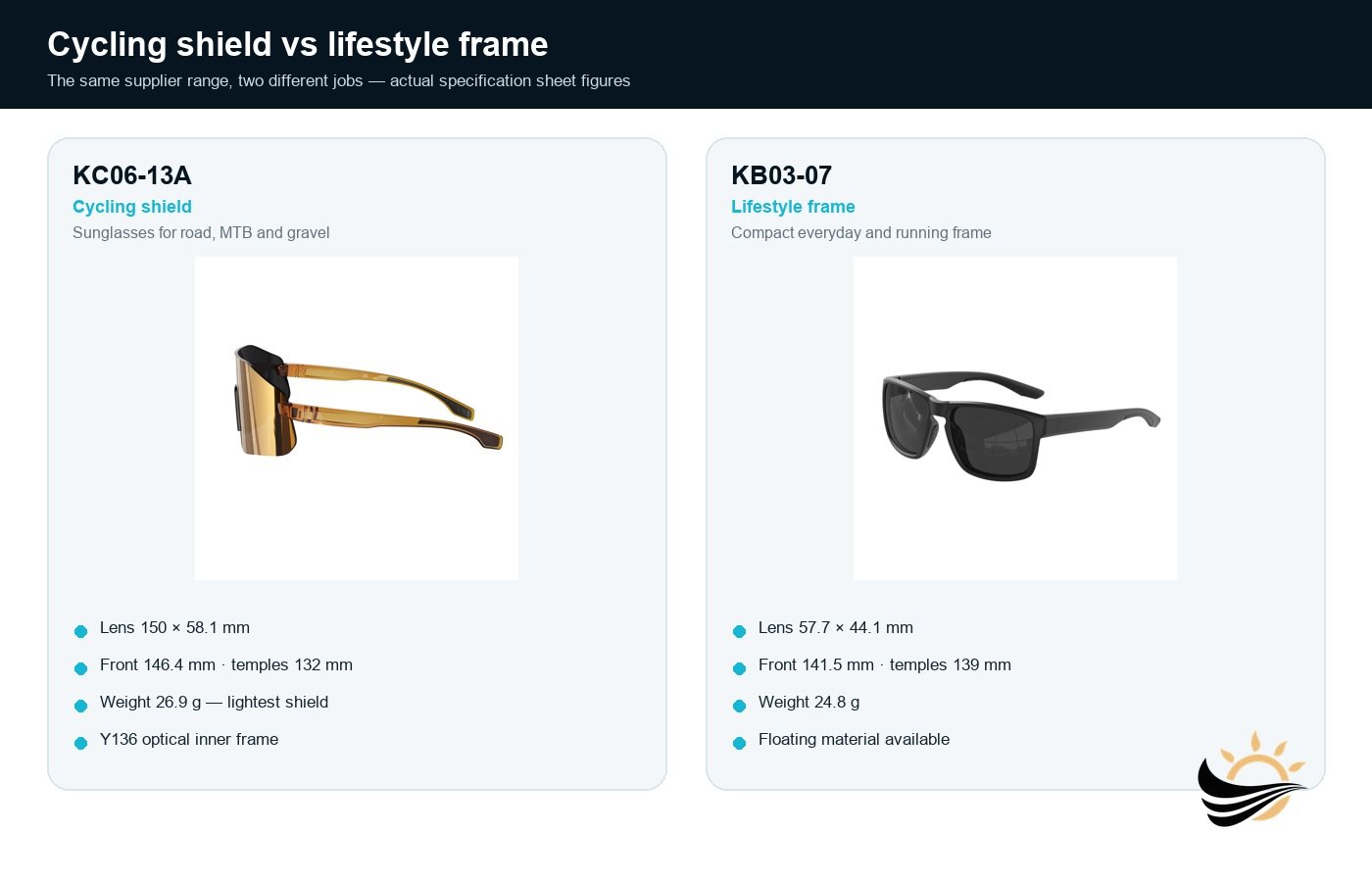
Which WORLUX models sit on each side
| Use case | Models | Why |
|---|---|---|
| Road and MTB cycling | KC06-13A, KC07-15K, KC08-16K, KC01-01, KC01-02, KC02-03 | Shield and wrap shapes, 26.9–33.8 g, optical inner frame available on most models for prescription wearers |
| Running and training | KB03-07, KB05-11 | Full-rim, 23.3–24.8 g, secure 139–140 mm temples, easy to stock in several colourways |
| Fishing and waterside | KA01-01, KA02-03, KM-Y361F, KM-Y362F | Floating material available, TAC polarized lenses, side shields on the KM series |
| Golf and everyday | KD02-02, K502-06 | Semi-rimless RX-ready groove, and a 19.2 g sports optical frame |
If you serve both sports, stock them differently
- Do not merge the two into one SKU list. A shield frame does not sell to runners, and a small lifestyle frame looks under-specified to road cyclists.
- Lead with one hero model per sport, then colour. Colour is what sells the second and third unit; shape is what sells the first.
- Prescription support is a margin opportunity. Four of our cycling models and the semi-rimless KD02-02 accept an optical inner frame, which lets you sell to the large share of cyclists who wear glasses.
- Check what your customers can legally be sold as. Category 3 is the standard choice for road use; anything you intend to sell for driving at night is a compliance problem in every market we ship to.
Sampling both directions
Ready-to-ship stock ships from low minimums — 1–2 pcs depending on the model, and mixed batches are accepted. Adding your logo to a stock colourway starts at 50 pcs per colour. An ODM colour outside the stock range starts at 300 pcs per colour, with up to two colours per order. Custom production runs around 40 days after artwork and sample approval.
Request a QuoteLet’s Work Together
Building a Range for Two Sports?
Send us the sports you sell for, the quantities and the colours you have in mind — we will come back with model suggestions and pricing.