
Buyer guide
Snowboard Goggles vs Ski Goggles: What Actually Differs
The two markets are sold as if they need different products. Most of the difference is riding position, ventilation priority and the tints a rider carries — not the goggles themselves. Here is what actually changes, and what to write into a purchase order.
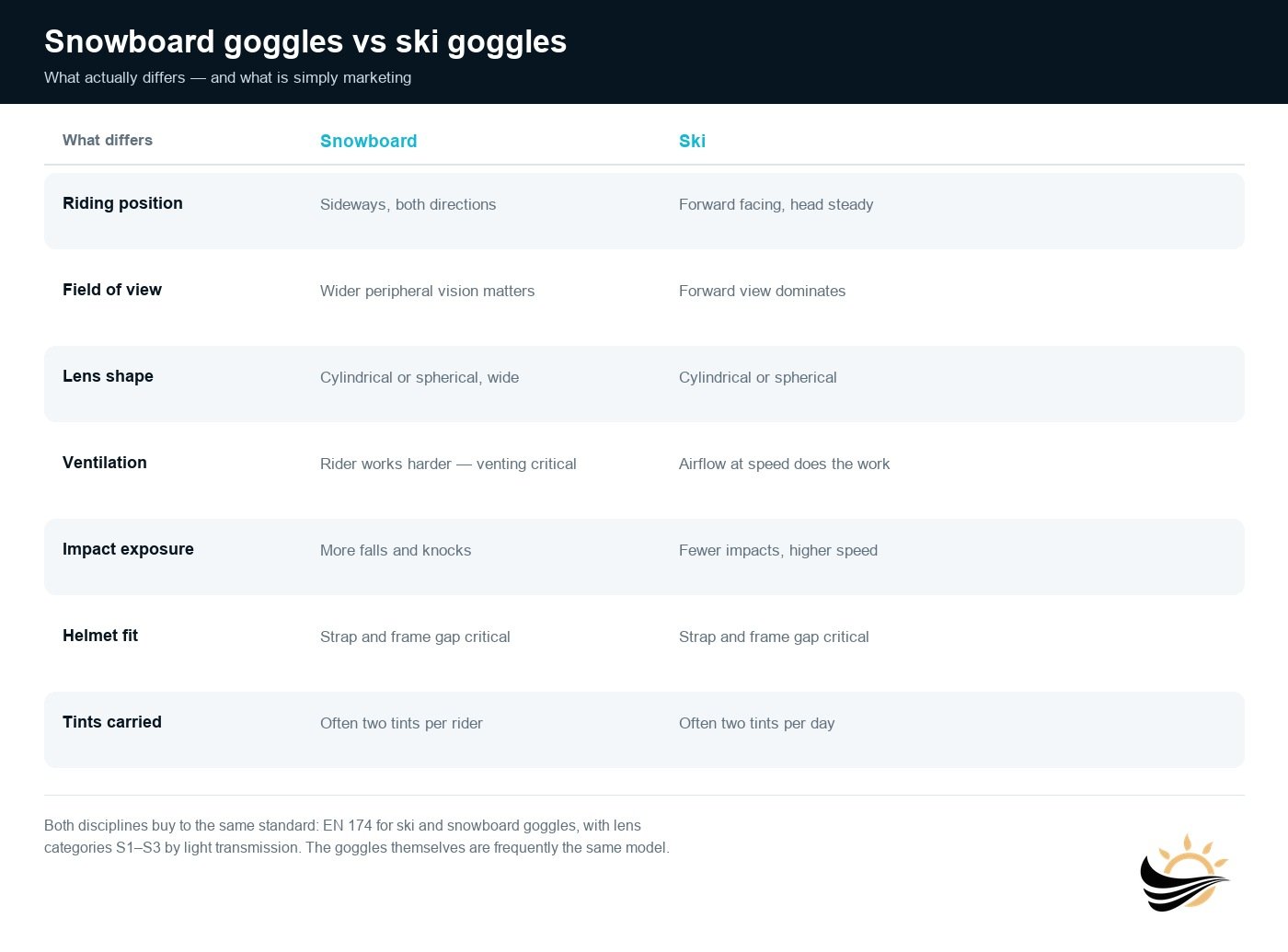
Search “snowboard goggles vs ski goggles” and most results describe two separate products. In practice, a modern all-mountain goggle is bought by both groups, and the specification that matters is the same: lens shape and field of view, ventilation, helmet fit, and which lens categories you are stocking.
The differences that do exist come from how the rider moves — and they affect what you should put on a shelf, not which factory you buy from.
Five differences that affect a purchase decision
1. Riding position changes the field of view you need
A snowboarder rides sideways and looks across the slope, so peripheral vision matters more. A skier faces forward with a steadier head position, so the forward view dominates. That is why wide cylindrical and spherical lenses sell strongly into snowboard ranges, while skiers can be perfectly happy with a slightly narrower lens.
2. Ventilation priorities are different
Snowboarders spend more time working hard — hiking, park laps, getting up after a fall — which raises the temperature gap inside the goggle and makes venting and foam quality critical. Skiers generate airflow simply by moving faster. Both buyers should be asking about double-layer lens construction and foam, but a snowboard range will notice a weak anti-fog build first.
3. Impact exposure differs
Snowboarders fall more often; skiers fall less often but at higher speed. For a buyer, the practical result is the same: the frame has to be flexible and impact-resistant, which is why TPU frames with high-density foam are the norm in both categories.
4. Helmet fit matters to both, and it is where returns come from
The strap width, the frame flex and the gap between goggle and helmet decide whether a customer keeps the product. This is the single most common reason for returns in snow eyewear, and it is not a snowboard-versus-ski question at all — it is a fit question.
5. The tints a rider carries
Snowboarders often own two lenses for different days; skiers often change lenses during the same day as light shifts. Either way, the commercial conclusion is the same: a magnetic or quick-change system lets you sell fewer frames and more lenses, which is easier to stock and easier to reorder.
Lens categories: the part buyers misread most
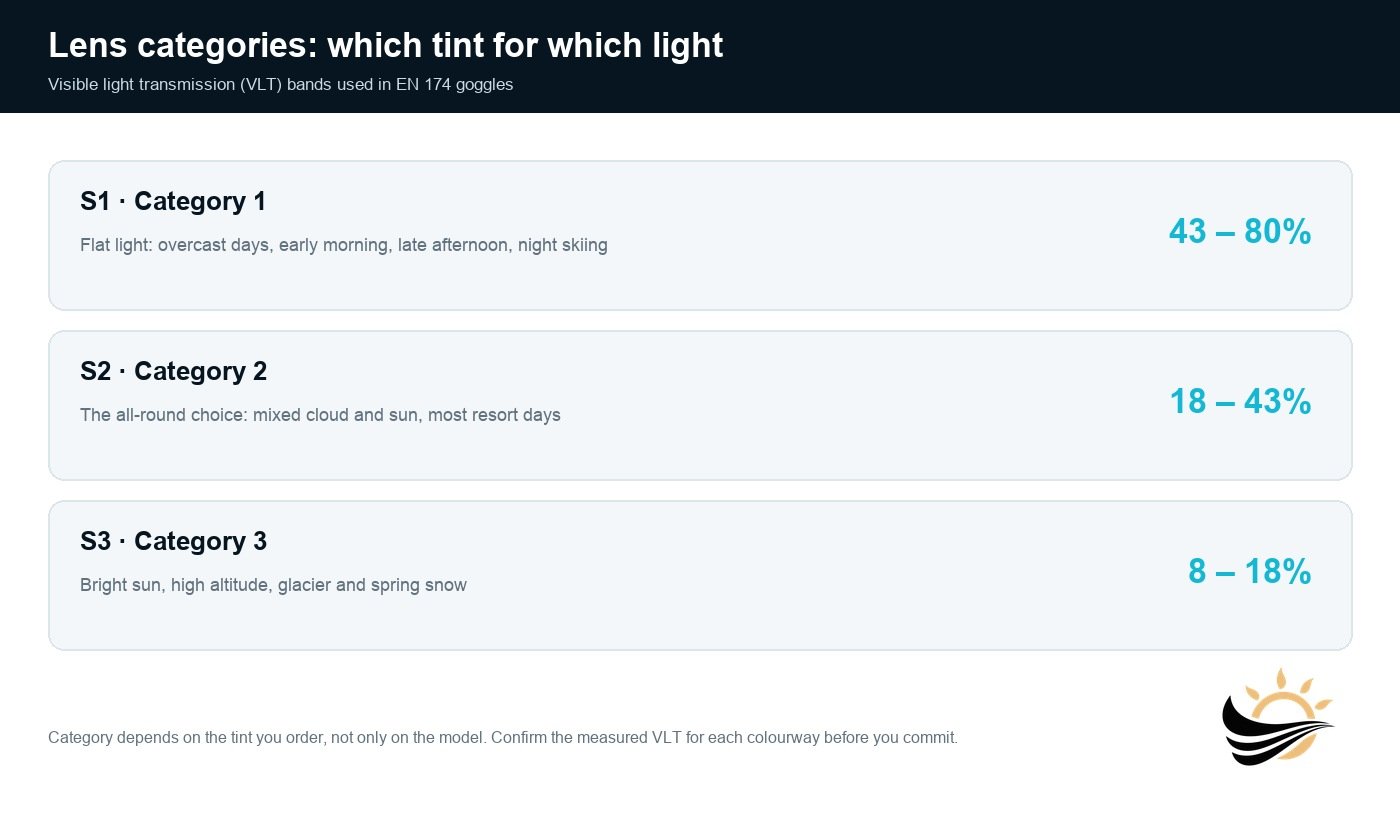
Goggle lenses are classified by visible light transmission (VLT), not by how dark they look. Category 1 (43–80%) suits flat light, overcast days and night skiing. Category 2 (18–43%) is the all-round choice for mixed conditions. Category 3 (8–18%) is for bright sun, high altitude and spring snow.
Can one goggle model serve both markets?
Yes — and in most ranges it already does. Our own snow platform, HX055, is quoted for skiing and snowboarding together: a large cylindrical lens for peripheral vision, a magnetic quick-change system, double-layer anti-fog construction with REVO coating, and OTG geometry so it fits over prescription glasses.
That crossover is why the “snowboard versus ski” framing is more useful for merchandising than for sourcing: you are choosing the lens range and the tints, not two different products.
What buyers should stock
| Decision | Practical recommendation |
|---|---|
| Lens categories | Stock at least two: category 2 for mixed conditions and category 3 for bright days. Category 1 is worth adding if you sell into Nordic or night-skiing markets. |
| Frame platform | Choose a magnetic or quick-change platform. You then sell extra lenses instead of extra frames, which reduces stock risk. |
| Colourways | Two strap tones cover most displays — a neutral (black or olive) plus one colour that reads on a shelf. |
| OTG | Carry at least one OTG-compatible model. A meaningful share of adult buyers wear prescription glasses. |
| Compliance | Ski and snowboard goggles are bought to EN 174. Ask for the test report that names your model and tint, not a general statement. |
What to write in the purchase specification
- Model and lens tint — including the measured VLT or category for that specific colourway.
- Lens shape — cylindrical or spherical, and the lens dimensions.
- Anti-fog build — double-layer lens, and foam layers.
- OTG or not — state it explicitly if you are selling to prescription wearers.
- Strap and logo — colour, logo position, and whether the silicone grip strips are required.
- Packaging — pouch, box or private label, with the quantity that triggers each option.
- Documents — the standards that apply and which files ship with the order.
Quoting a snow programme?
Ready-to-ship stock ships from low minimums — 1–2 pcs depending on the model, and mixed batches are accepted. Adding your logo to a stock colourway starts at 50 pcs per colour. An ODM colour outside the stock range starts at 300 pcs per colour, with up to two colours per order. Custom production runs around 40 days after artwork and sample approval.
Request a Quote See the ski goggle rangeLet’s Work Together
Sourcing Ski and Snowboard Goggles?
Ready-to-ship stock ships from low minimums — 1–2 pcs depending on the model, and mixed batches are accepted. Adding your logo to a stock colourway starts at 50 pcs per colour. An ODM colour outside the stock range starts at 300 pcs per colour, with up to two colours per order. Custom production runs around 40 days after artwork and sample approval.