
Buyer guide
Sport Sunglasses Lens Materials: TAC, PC and Nylon Polarized Compared
Price is the first thing buyers compare and the last thing that causes returns. The lens specification is the opposite. Here is what the four lens options mean, what to write into a purchase order, and which questions separate a quotation you can compare from one you cannot.
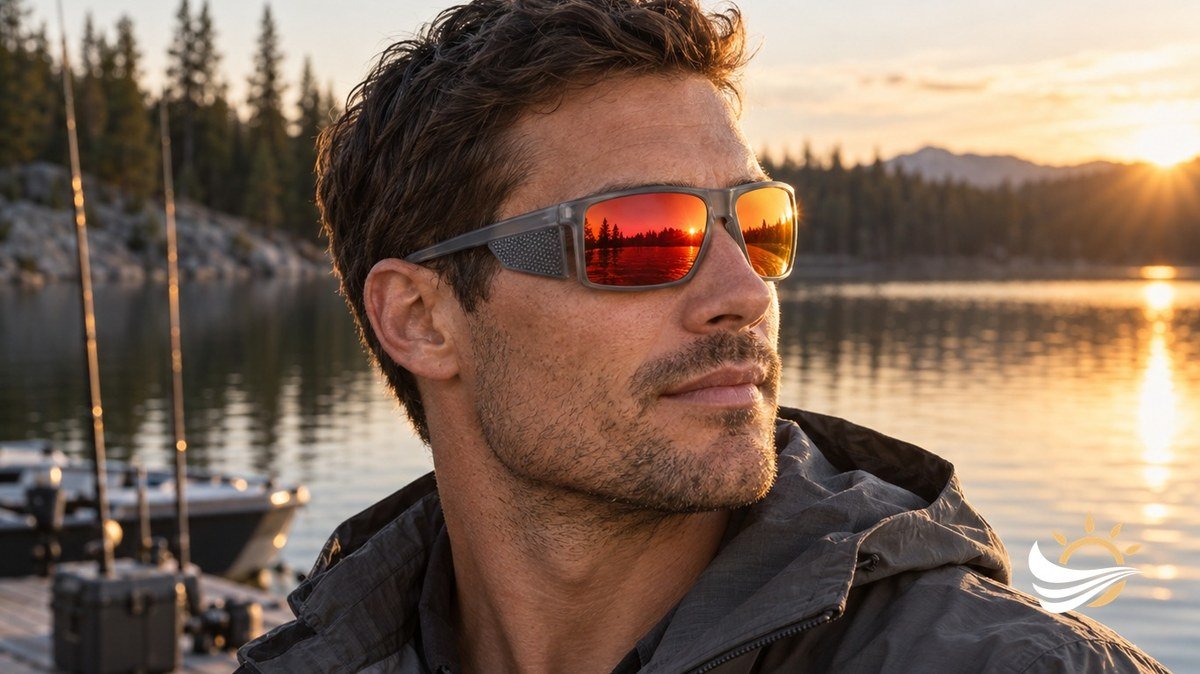
Two suppliers quote the same frame at the same price. One ships a lens that survives a season on the water; the other produces complaints in month three. The difference is almost never the frame — it is the lens material, the tint and the category, and how precisely those were written into the order.
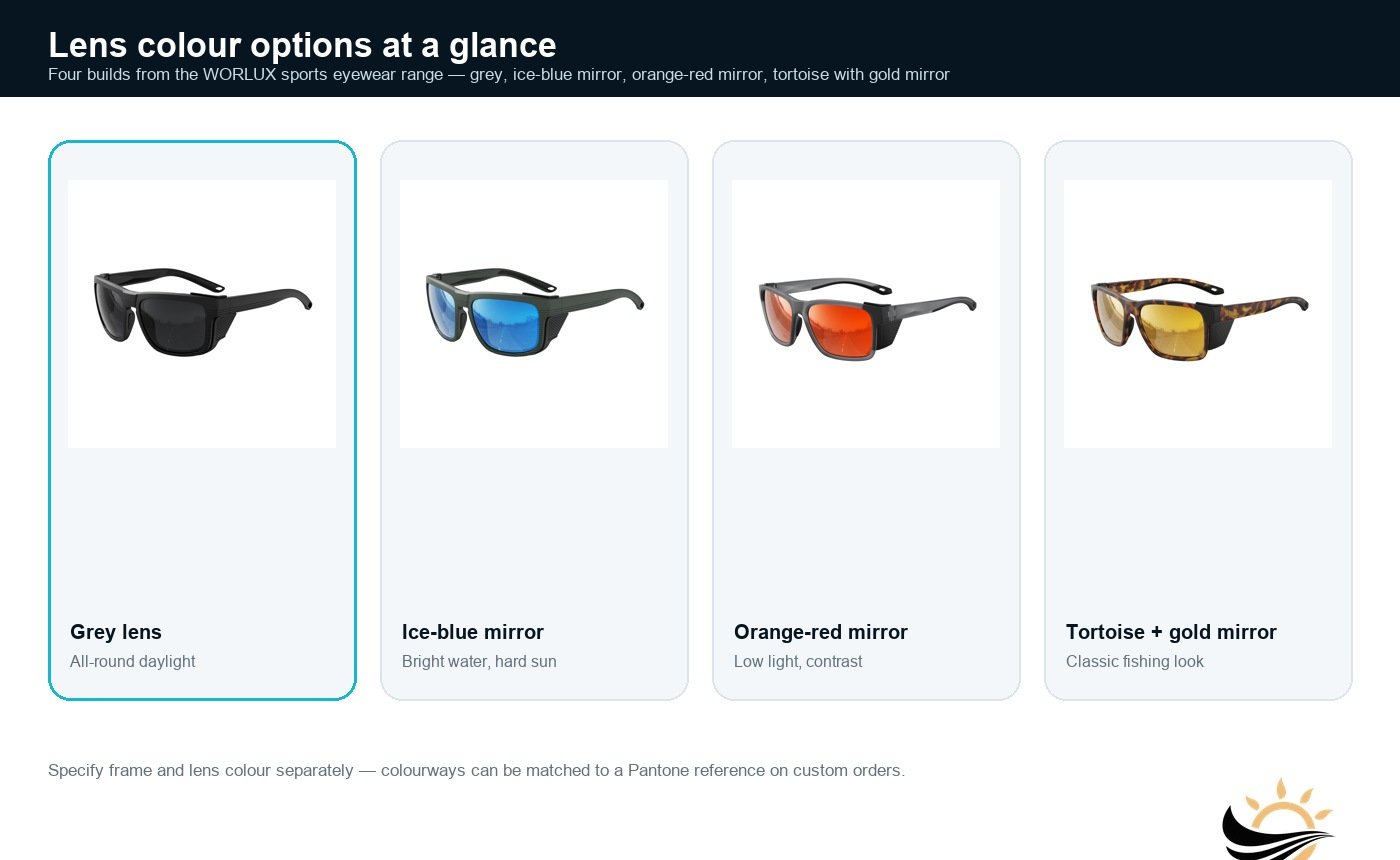
The four lens options we are asked to quote
Across the range we quote four lens specifications. They are not interchangeable, and the price difference between them is not the most important difference.
| Lens option | Polarized version offered | Where buyers typically use it |
|---|---|---|
| TAC | Yes — quoted as TAC polarized | Fishing and outdoor models, where glare off water matters most |
| PC 1.8 | No | Cycling and impact-conscious programmes |
| PC polarized | Yes | Cycling and sport ranges that also need glare control |
| Nylon polarized | Yes | Premium builds and wrap frames |
What actually decides whether a lens suits your market
Four properties do the work. None of them is visible in a product photo.
- Polarized or not. Polarization filters light reflected from horizontal surfaces — water, wet roads, boat decks. If your customers fish, it is the single feature they ask about. If they ride at speed in mixed light, it matters less.
- Lens category and measured transmission. Category 2 is 18–43% light transmission, category 3 is 8–18%. Our own tested samples came back at 21.12% for a PC lens (category 2) and 9.09% for an ice-blue TAC lens (category 3) — both PASS. Ask for the measured number, not just the category.
- UV protection. UV400 means the lens blocks at least 99% of UVA and UVB. It is a claim that must be supported by a laboratory report, not by a catalogue line.
- Material behaviour in your climate. Heat, salt and chemical exposure are the usual causes of premature lens failure. Ask what testing the supplier holds — our nylon material, for example, was tested by SGS to FDA 21 CFR 177.1500 with PASS results across four simulants.
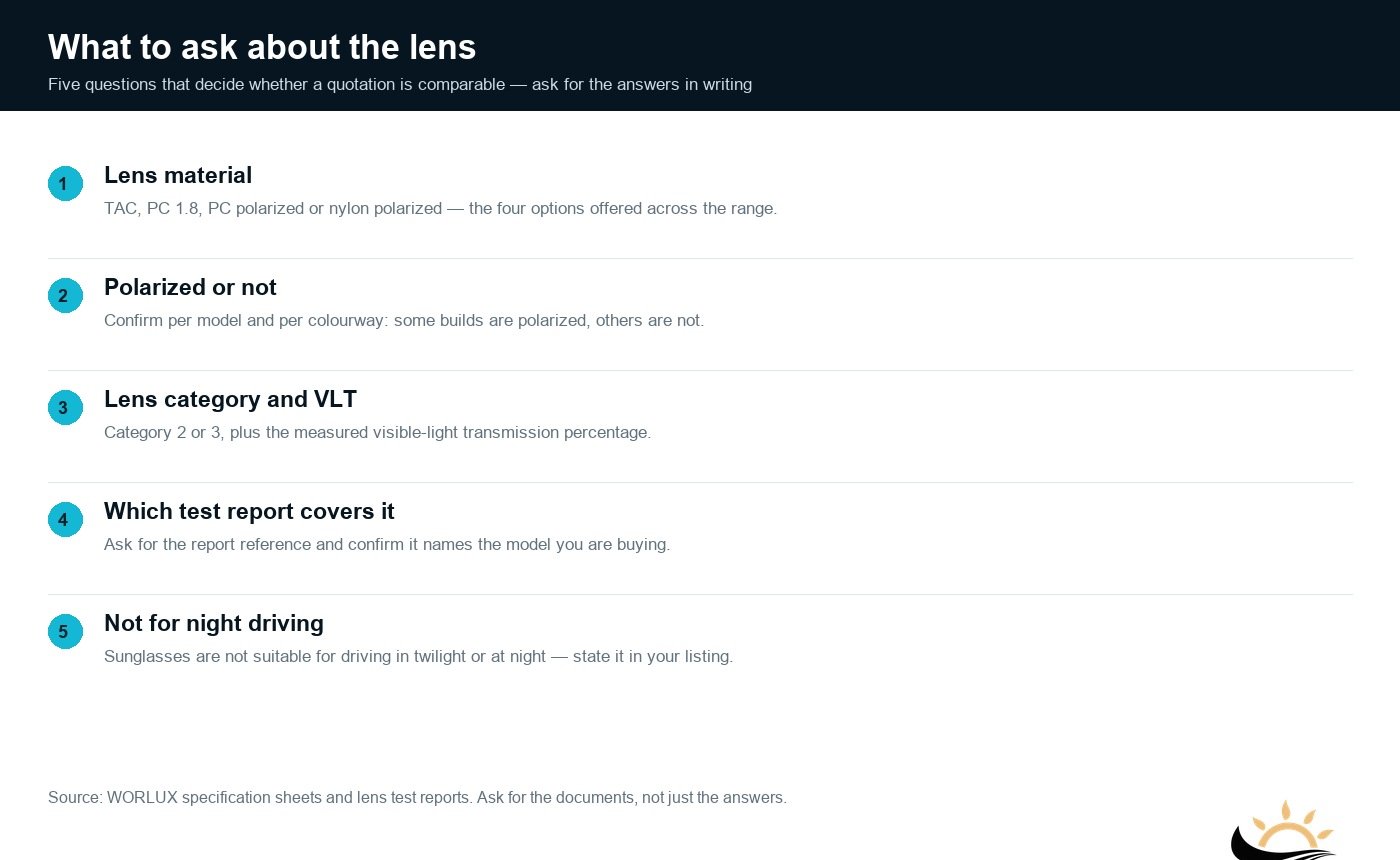
The mistake buyers make: assuming the model defines the category
Lens category depends on the tint you order, not only on the model. The same frame quoted in grey, ice blue, orange-red or amber can land in different categories with different transmission values. This is why a specification that says only “KC06-13A, category 3” is incomplete: it does not say which colourway was tested.
Write the order as model + colourway + lens material + category + polarized (yes/no). That single line prevents the most common dispute in this category of product.
What to put in the purchase specification
| Field | What to write |
|---|---|
| Model and colourway | e.g. KM-Y362F, matte translucent grey frame with orange-red mirrored lens |
| Lens material | TAC, PC 1.8, PC polarized or nylon polarized — spelled out, not as a code |
| Polarized | Yes or no, confirmed per colourway |
| Category and transmission | Category 2 or 3, plus the measured VLT percentage if the supplier holds it |
| UV claim | UV400, with the report reference that supports it |
| Labelling | Category marking on the temple, and the night-driving warning where your market requires it |
Which models in the range use which lens
The practical starting points, from the current specification sheet:
- Fishing and waterside — KA01-01 and KA02-03 in the KA range, plus the side-shield KM-Y361F, KM-Y360F and KM-Y362F, all built on a TAC polarized lens.
- Cycling shields — KC06-13A (the lightest at 26.9 g), KC02-03 (widest 151 mm front) and KC07-15K (frameless). All accept the optical inner frame for prescription wearers.
- Lightweight everyday frames — K502-06 at 19.2 g and the KB lifestyle models.
Want the lens documents before you decide?
Tell us the model, colourway and market, and we will confirm which lens category applies and send the test report that covers it — see certifications and compliance for what we hold today.
Request a Quote Download the catalogLet’s Work Together
Comparing Two Quotations?
Send us the specification you were quoted — we will tell you which parts of it are comparable and which are not.